Tuesday, January 11, 2011

Race, rage, redemption - and pirates

Take One Candle Light a Room

by Susan Straight

Pantheon Books


“You a lie!” someone yells in the opening chapters of this powerful book about family ties, the notion of home and one woman’s search for redemption . And in many ways, Fantine Antoine, successful travel writer and narrator of this book, does feel like one. Secretive about her origins, camouflaged by a skin tone that confuses most people about her racial lineage, she makes her home among strangers, distancing herself from her roots with education and a lifestyle her family can neither comprehend nor appreciate.


For Fantine's family is bound by ties far stronger than blood – they are brought together by the shared trauma of rape, decades of racial prejudice and violence, and the insularity that comes from being unable to trust anyone outside of their tribe. But though to outward glance she has walked away from it all, she still wears the scars of her heritage close, in her inability to commit to relationships, in the distance she must necessarily keep even from those closest to her.


All this changes, however, when her godson, the academically gifted Victor – and the one family member who seems to be following in her footsteps - becomes involved in a random act of gang violence. As she races against time to reach him and save him from the dark future that claims so many young black men of his generation, Fantine finds herself reconnecting with her estranged family and confronting, at last, the memories and dark secrets she has tried to leave behind. After years of being ‘invisible’ in her neutral complexion, carefully chosen clothes and the privileges her job offers, Fantine discovers, as she drives across America with her father, the reality of being black , when even an act as innocent as driving at night comes fraught with danger. “You just a nigger,”, her father says, a man who has survived great violence and meted out his version of it. “You not a writer. You with me.You tite souri (mouse). For them.” And sure enough, despite her laptop and vocabulary, she is mistaken for a prostitute (“a low-rent Halle Berry”) by a passing white couple and duly propositioned.

As a writer Straight is known for her extraordinary ear for dialogue, and ‘Take One Candle..’ moves effortlessly between patois , street jargon and Fantine’s articulate, writerly voice. ( ‘You made me fall in love,’ a professor tells her, after reading her work. ) Through the anguished inner voice of her protagonist, and the stories of the resilient men and women who came before her, Straight does even more. In an essay I read a while ago,about Haitians who dared raise their voice against political oppression, writer Edwidge Danticat defines ‘ guapa’ - the ‘courageous beauty’ she sees in the actions of these artists, writers and activists. With ‘Take One Candle..’ Straight gives us a glimpse of hers, returning to issues she has so eloquently examined in her earlier books – race; prejudice; the burden of painful cultural memory and its crippling effects across generations; the weight of love, often as damaging as it is redemptive.


At the heart of this book is the relationship Fantine shares with Victor - complex, fraught with tension, laced as much with a frail resentment as it is affection. In many ways, it springs to life only when she realizes she may lose him. Until the moment this happens, you can sense a diffidence on her part to bridge the gap she keeps between them, and his own pained , but silent acceptance of it. She brings him gifts, expensive mementos from the places she visits, yet is unable to offer him shelter the one night he needs it the most. For, much as he is like her, Victor is still a painful reminder of the past for Fantine – his doomed mother was once her best friend, the secrets of his parents’ death her unshed burden. Growing up, Victor has survived abuse and severe deprivation, scraping by only because of the largesse of the clan. Fantine, black sheep of this family, has rarely stepped in to help him; yet, she notes, as much with pride as regret, she seems to be the person he wants most to emulate. “People like us were not meant to measure success in the same way our families did,” Fantine observes. "We were failures to them.. And now Victor wanted… to be me.” But what they do have in common is a love of words, and it is this love that forges the tenuous bond that keeps Fantine on Victor’s tracks as he hurtles across America towards his doom, with little more than his cellphone in hand.


Fantine does eventually catch up with Victor, only to lose him again when he inexplicably starts behaving like the boys he has been trying to escape till now, and sets out on a hair brained treasure hunt of his own. Given how gripping the story has been till this point, and how drawn I was into Fantine's world, Victor's volte face made no sense whatsoever to me. It also alters the trajectory of the plot , taut and grounded until now, to embrace, in one great swoop, pirate yarns, flood waters (dame Katrina herself) death defying rescues, romance, ghosts , even the odd miracle.

Yet stick with Fantine - and Straight - as they negotiate this strange terrain , for a finale as satisfying as it is cinematic.


Friday, December 24, 2010

Love in the Time of Paranoia


Who shall live and who shall die
Who at the measure of days and who before
Who by fire and who by water
Who by the sword and who by wild beasts
Who shall have rest and who shall go wandering
Who shall be brought low and who shall be raised high.


Mitchell James Kaplan’s debut novel, which takes its name from the words of this sacred Hebrew piyyut , follows the fortunes of one man at a time of great social and political turbulence. 15th century Spain was the epicenter of some world-changing tremors – the conquest of Muslim-dominated Granada by Queen Isabel; the establishment of the Inquisition to reinforce the power of the Church while displacing thousands of Muslims and Jews across the world, and- that most famous of nautical goof ups, Christopher Columbus’ ‘discovery’ of the New World .


Into these historical facts, Kaplan deftly weaves a story of a man caught in a crisis of faith. This is no ordinary man; Kaplan ambitiously chooses as his protagonist the powerful and charismatic Luis de Santángel, an influential member of the court, unscrupulous accomplice to King Ferdinand in his quest for power, and financier to the gamble that was Columbus’ quest for Asia. But Santángel was also a third generation converso, or New Christian-his forefathers having abandoned the Jewish faith - who was implicated in the murder of an Inquisitor and lost several members of his family to the Inquisition.

History shows that the conversos were never entirely accepted, their status as former Jews or Muslims always making them suspect .“You think you’re one of them…”, Santángel bitterly observes to his brother Estefan, a man who hides behind a boisterous show of Christian feeling. ”But neither you nor I shall ever be one of them, no matter how much we drink or take confession.”.


Kaplan interprets Santángel as a man whose revulsion at the horrors and hypocricy of the Inquisition gradually turn him from skeptical converso to covert Jew. (“ Where they see a conspiracy of New Christians,” he says, “I see… history. Shared history. And history, memories, how can you escape them?”) He turns to the comforting fold of his abandoned faith, secretly practicing Jewish rituals and studying ancient Hebrew texts with the help of a young scribe. When the scribe is betrayed and tortured by the Inquisition into confessing his ‘crimes’ and naming accomplices, Santángel has the Inquisitor murdered. He soon finds that his power and wealth are little protection, given his suspect status as a New Christian. He is arrested, before his proximity to King Ferdinand comes to his aid, but is helpless to prevent the punishment of his son and the torture and murder of his brother.


Running parallel to Santángel’s story is that of Judith Migdal, a young woman living in the Jewish quarter of the Muslim kingdom of Granada. Judith, a devout Jew, defies social convention by refusing marriage and single handedly taking over her murdered brother’s business and the care of his family. Santángel meets her on a visit to the vizir of Granada, but theirs is a romance doomed; Santángel is arrested, while the Christian occupation of Granada turns Judith and thousands of Jews like her into homeless refugees. Also playing a role in Santángel’s persecution is the Toledoth Yeshu, a Hebrew scroll of unknown origins, that Colon gives to him. Suggesting an alternate version to Jesus’ origins, the scroll ,though hardly comparable to the hate mongering of anti-Semitic propaganda like the Fortalitium Fidei ,has often been misrepresented as anti–Christian, and becomes, in this book, a powerful stimulus in Queen Isabel’s fanatical desire to conquer Granada.


The story moves seamlessly between theological debate, moments of intimacy and graphic violence, with the odd burst of florid prose'. Kaplan’s rendering of Santángel reminded me of Thomas Cromwell, flawed star of ‘Wolf Hall’, Hilary Mantel’s literary juggernaut – amoral, conniving, as much a power hungry opportunist as the monarch he supports, then blackmails. In Kaplan’s assured hands, however, Santángel is also an intriguing character, tortured by his love and the consequences of his beliefs. By contrast, Kaplan’s vision of Colon/ Columbus is far more flattering – devious, yes, in his single-minded dedication to his vocation, but also intellectually curious, and tolerant of cultures foreign to his own (in a sub-plot, he secretly supports Judith’s business at a time when anti-Semitic feeling runs particularly high).


But the character who stands out as truly heroic is one who starts off as an underdog - Estefan, a man who feigns an affinity to primitive Christian rituals, only to openly defy the Inquisition when his young nephew is arrested. “No one cares a straw what you believe, Luis,” Estefan tells his brother, rather prophetically, at the beginning of the book. “No one cares what I believe, in the black dungeon of my heart. That’s the outrageous joke behind this madness.” And later, “Where’s the other cheek?” he taunts the men arresting him for a drunken tirade against Torquemada’s ‘splenetic choirboys’ and their zeal for violence.”Where is He?” Needless to say, the Inquisition’s response is brutal.

By Fire, By Water’ makes for compulsive reading with its lucid prose and strong characters, in a narrative where the research never overpowers the story.

Thanks to Mitchell James Kaplan for sending Bookblah a review copy of his book.

Tuesday, December 7, 2010

Emma Freke.. as is everybody!

I, Emma Freke

Elizabeth Atkinson

Carolhoda Books


The best coming of age stories are often about great voyages and life-changing encounters, yet are really about internal journeys – about children making that first, significant step towards maturity, and away from the fears that have curbed them. ‘I, Emma Freke’ is about one such journey, and a girl’s struggle to find her place in the world.Released early last month, the book has already won a Moonbeam Children's Book award.


Emma Freke is smarter than anyone she knows. Right from the opening chapters of this story about a child’s quest for family and a sense of belonging, where she bemusedly endures a school counsellor’s ham - handed attempts to boost her ‘socialization skills’, we know she is different – knowing, self aware, and possessed of both the smarts and a wry sense of humour. And yet, she finds herself defined, and utterly trapped, by the connotations of her name.


For Emma would like nothing better than to be shorter, dumber and invisible. At twelve she is, by her own admission, the “..tallest, palest and saddest girl in all of Homeport.” Often mistaken for an adult, saddled with her awkward moniker, - “My mother forgot to say it out loud when I was born”, she explains to everyone who says ‘Am a freak’ for the first time - her alarmingly red hair and mortifyingly great height (“like a target visible from space”, she rues), school is an ordeal of sniggering classmates and insensitive teachers.


Sadly, home isn’t much better - a father she has never met but whose unfortunate name she is stuck with, a cranky grandfather she often has to look after, and a flighty irresponsible mother who will think nothing of passing her daughter off as an employee in order to hang on to a younger boyfriend. Worse, her best – and only – friend Penelope possesses everything she lacks – two doting mothers, a lovely house, irresistible charm and unwavering optimism. Is it any wonder that she desperately hopes she is adopted? But though her mother manages to shatter that one illusion as well, she does give Emma something else instead – a chance to meet the Frekes, her father’s side of the family.


What follows is an account, by parts sad and funny, of Emma’s discovery of herself among the Frekes . Surrounded for the first time in her life by people as tall , red headed and obsessive about order as she is, befriended and admired at last by girls her own age , Emma finally feels she belongs . Yet all is not well with the Frekes ; not only do they shy away from the family name (Frecky, they insist. Rhymes with Becky.) and cower before the family matriarch, they seem to dislike their own freaks too – short, dark haired and very irreverent Fred Freke. It will take a twelve year old’s wisdom and spirited stand in defence of a fellow freak for the Frekes to begin acting like a family, and for Emma to realize the worth of her own.


Atkinson keeps it real, and writes from the heart – reading this book, I was drawn right into Emma’s sad and lonely world, feeling all of her pain and heartache with her. Who, after all, has not felt this keen sense of isolation at some time or other in their youth? Emma’s is also a world sorely lacking reliable adults, save for the friendly neighbourhood librarian or Penelope’s mothers (a very matter of fact inclusion of an unconventional marriage in this story about embracing diversity, that had me nodding in approval as I read); yet, Atkinson’s crafting of these fumbling, fallible and very believable grown ups makes them difficult to dislike, be it Emma’s mom with her fetish for all things New Age, her elusive father or the domineering Aunt Pat. By the end, as Emma finally makes her way home and gracefully embraces her life (and name) for what it is – unconditionally her own, and defined not by other people and their ideas, but her own altered vision of herself - you realize that this simple action has changed their lives as much as her own.

Heart warming, self affirming, funny – a book for the freak in each one of us.

Thanks to Skye Wentworth sending me a copy of the book to review.


Crossposted here.

Saturday, December 4, 2010

Things unsaid


Little Pieces – This Side of Japan

Michael Hoffman

Virtual Bookroom Publishing


This book has been a challenge to read and review. The stories it contains are rather like the dragonflies that appear in one of them – seemingly simple and light, yet elusive to the hand seeking to pin down and label them. If the art of a good short story lies less in the words it is made of than in the negative spaces between those words , then author Michael Hoffman is clearly an artist of considerable skill.

In these six spare stories set in contemporary Japan, Hoffman’s characters struggle with alienation, the claustrophobic binds of family and lack of direction. In stories like ‘The Miracle’ and ‘The Concussion’, both largely feverish monologues, we are led into the complex interior lives of their troubled protagonists as they grapple with their demons. Ambivalence is a dominant theme in these stories, as is a distinct preoccupation with violent death; characters either dream about bloody rampages, obsess over news reports of murders, contemplate (but step away from) suicide, or succumb to violence either as perpetrator or victim. The repetitive appearances of these little scenes through the book are one of the few things that rankle about this otherwise well written book. If these do not deter the reader, it is only because Hoffman’s gentle yet incisive eye ensures that these are neither dark stories nor repulsive characters.


First Snow’, which sets the tone and pace of this book, is a description of an encounter between a directionless, unemployed man and the woman who was once his babysitter. The evening progresses from reminiscence to confession; he dreams of escape, she seeks redemption for a past indiscretion. The falling snow seems to symbolize the freedom of unburdening for her; he realizes he needs to look inward for the answers he seeks. ‘It’s only when I open my eyes that I feel cold…” he thinks, poised on the threshold between his old life and the unknown new.


Dragonflies’ , the longest story in this collection, cunningly reveals layers of ideas as it alternates between the lives of Hiranuma and Sawamoto, both middle aged men who have been friends since childhood. One, a writer of some renown, struggles to write an essay on a revered peer, even as he puzzles over his wife Shizuko’s agitation over her music teacher’s seeming dalliance with a young girl. Her real reasons for her anger soon become evident, leaving him startled and hurt, yet also making him realize some important things about his own life. The other, Sawamoto, a philandering college professor and self confessed “bad man”, faced with losing his job to a more dynamic colleague, drunkenly ponders suicide and rues the pointlessness of love, only to go home and be surprised by its presence in his life. Running parallel to this story is a tale about a painting so aggrandized that it invariably disappoints the people who flock to view it. What this painting symbolizes – love, good reputation, Shizuko or even Sawamoto himself – is left entirely to our interpretation. So also the miracle in the story of that name, which could be any one of a number of things – the calm self assurance of Emi’s new friend; the hope he suggests for her future; the fact that, despite their darkest fears, neither Emi nor her mother is murdered by the end of the story. Or is it the metamorphosis of Emi’s mother from tormenter to protector?


My favourite story in the book – ‘Sonoko’ – is about a woman who escapes her colleagues, her overbearing mother and an ardent suitor, for the solitude of a hotel room, a book and conversations with her deceased father . ‘Sipping scalding tea with my eyes closed …. That is the greatest happiness we humans can know on earth,” she thinks, as she too, like Tamaki in First Snow’, turns inward for solace. Sonoko is, in direct contrast to Hoffman’s other female characters, at peace with herself and her devoted study of 12th century Japanese literature. Perhaps this peace is a result of her dying father’s last words to her, claiming to be an alien from another world . For she lives two lives, as he too claims to have done,switching periodically from ‘‘..modern, single, financially independent woman..’ to herself. Solitude is her true love - her Genji - for which she calmly chooses to embrace death (you guessed it, a violent one) through one last, socially appropriate gesture.


Crises of faith seem to be a strong subtext in atleast four of these stories. Nearly all of Hoffman’s central characters are Christian ( a curious fact given that Japan is predominantly Shinto). Emi in ‘The Miracle’ constantly dialogues with her God, as she struggles to keep her fragile hold on her sanity ; Stephen in ‘The Concussion’ turns away from Christ in a gesture of rebellion against his gentle missionary parents. Elsewhere characters debate God’s presence, cling to their pastors, obsess over death – clearly faith, in Hoffman’s Japan, is as much a source of distress as comfort. Even when a character isn't overtly Christian, Hoffman seems unable to keep him free of religious symbolism - Tamaki in 'First Snow' dreams of moving to India, 'a world of golden temples gleaming under a searing sun'; Sawamoto quips about travelling to India to bathe in the Ganges, an act typically associated with spiritual cleansing.


Hoffman also enjoys teasing his readers along. ‘The Concussion’ seems to doff its hat at Kafka with its opening lines – an elderly character awaiting trial for a crime he is unaware of – then follows in the wake of his reminiscences as he traces the path of his violent life – and his rage - back to a single childhood incident. Bit by bit, you realize that his prison and his captor exist entirely in his mind and what he really seeks is forgiveness for an entirely different crime. I also enjoyed the structure of ‘Little Pieces’, the final story in the book, which swings seamlessly between four different voices, to tell us the strange and tragic story of Sayaka and Kenichi, before ending in a disturbing freeze frame right in the middle of a conversation about death.


Aside from the writer’s predilection with those twin themes, - Christianity and death by bludgeoning – elements that do not always justify their presence, ‘Little Pieces’ is an elegant and well observed examination of the human condition.

Thursday, November 11, 2010

The floating worlds of the exile

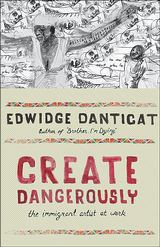
Create Dangerously : The immigrant artist at work

by Edwidge Danticat

Princeton University Press

The poet turns the world to glass, and shows us all the things in their right series and procession,’ Edwidge Danticat writes, quoting Emerson. In these twelve eloquent essays, Danticat does just that as she examines the many dilemmas of being a creative person exiled from their homeland,. Through the prism of her personal experiences and tenuous associations with her homeland, and in her interpretations of its troubled history and that of individuals she has interacted with, Danticat paints us a portrait of her Haiti – her ‘floating world’ as it were, and its tortuous struggle for peace and stability.


Create dangerously, for people who read dangerously’. These words by Camus have defined Danticat’s development as a writer, and they are central to Danticat’s defence of what she deems the artist’s purpose – to bear witness. In essays like ‘Daughters of Memory’, ‘I Speak Out’ and ‘Acheiropoietos’ , she profiles Haitians who have done just that – borne witness to the atrocities committed on Haitians , displaying what she calls ‘guapa’ – a courageous beauty.


In the opening paragraphs of ‘Create Dangerously’, the first of these quiet yet powerful examinations of identity, Danticat walks us, with excruciating slowness through an execution. The two men at the centre of this gruesome tableau, Marcel Numa and Louis Drouin are members of a rebel group trying to bring down the Duvalier dictatorship, and the public spectacle of their deaths will haunt generations of Haitians. They certainly haunt Danticat, even though she wasn’t even born at the time of this incident. Quoting Camus again - “..a person’s creative work is nothing but a slow trek to rediscover, through the detours of art, those two or three images in whose presence his or her heart first opened.”- Danticat’s essays reveal how these, and other horrors have been akin to creation myths for creative Haitians like her, intrinsic to what Basquiat calls ‘cultural memory’ in ‘Welcoming Ghosts’, Danticat’s incisive exploration of the young artist’s work and influences.


Dangerous writing – and reading- had something of a rich past in Haiti under Duvalier, where even the suggestion of dissent was liable to get you killed. The title essay of the book examines how, in the claustrophobia that was life under the Duvaliers, people chose clandestine methods of voicing their anguish, through the secret staging of plays and the reading of classics by foreign, or long dead authors like Cesaire, Fanon and Camus. “The fact that death prevented one from being banished,” she wryly notes, “..made the ‘classic writers all the more appealing. “


Sadly, lesser mortals do not always enjoy this posthumous immunity. Does death reverse exile, Danticat wonders in ‘The Other Side of the Water’ , as she recalls her attempts to have her cousin Marius’s body flown home from Miami to Haiti for burial. For Marius, an illegal immigrant with AIDS, lacks the necessary documents needed for his final flight home and must wait in legal limbo until a solution -or his passport – is found.


Creative stifling, she observes, has effectively silenced whole generations of her countrymen; in turn, it has made the few, like her, who choose to speak out, seem like martyrs.. ”crazy Saints (who) stared out at the world, like lunatics – or quietly, like suicides..” This is not a sainthood Danticat wears lightly; for just under the surface of her words lurks her guilt at having ‘escaped’ (through migration to the United States) and becoming an ‘accident of literacy’ while thousands of Haitians remain uneducated and poverty ridden. She struggles with this notion of being privileged, and with her own identity, as she is repeatedly accused of being 'dyaspora' , and incapable of authenticity when writing about Haiti. Danticat faces this alienation even at home; an elderly relative mourning her dead son says, ‘‘I know it’s your work, but please don’t write what you think you know about Marius.”


Perhaps this is one of the crosses the immigrant writer must bear, regardless of their creative voice – this obligation to be ambassador of a culture and people she is rooted in through the accident of birth. It is a cross Danticat refuses , however; rather she asserts that , by virtue of her craft, she transcends her own geographical boundaries, taking on, with every reading of her work, the nationality of the individual reader. ’Are you free, my daughter?” asks a character at a crucial juncture in Danticat’s debut novel, ‘Breath, Eyes, Memory. Danticat seems to pose that very question to herself repeatedly. ‘Walk Straight’, for instance, describes her guilt and confusion over being accused of misrepresenting Haiti in her writing, particularly over the issue of ‘virginity testing’ that several characters in her debut novel endure. ‘I exploit no one more than myself’, she argues, emphasising her role as a fiction writer, who merely borrows from the truth around her. And yet, a hint of self deprecation creeps into her writing, as she describes, in ‘Flying Home’, how she was ‘at work’ during a national crisis, the inverted commas being her own.


As a writer, Danticat finds she must also battle a kind of collective amnesia. Recalling the sabliyes -the forgetting trees from Haitian lore, that slave ancestors stepped under to free themselves of their memories and dull the pain of leaving home, Danticat observes that the Haitian psyche seems unwilling to step away from their shade, choosing to forget their long and painful history of slavery. It is a history that repeats itself; for Haiti remains a lesser ‘other’ to more powerful neighbours like the United States, even during national crises like the earthquake that ravaged the island earlier this year. In the moving ‘Our Guernica’, the final essay in this collection, she reflects on this inequity, even as her family calmly deals with the loss of loved ones in the earthquake, and begin the process of rebuilding their lives.

It is these images of quiet resilience that are perhaps most telling of Danticat’s floating world, of a country picking up the pieces of its shattered identity yet again – a country and a people undeniably guapa. And it is in the unflinching portrayal of these people and this country, in Danticat’s graceful and passionate commitment to bearing witness to their anguish and their joys, that we glimpse the guapa in her writing as well.


Thanks to Princeton University Press for sending us a copy of the book to review.

Friday, November 5, 2010

The Half-made World, by Felix Gilman

You have to stop and take notice of a book endorsed not just by Eric Van Lustbader, but the queen –Ursula Le Guinn- herself. You stop, notice and, if you are in any way like me, you worry – about overkill, disappointment, and,if the book is indeed a winner, about that interminably long wait, accompanied by much teeth-gnashing, for Part Two to reach your grasping little hands.

A few lags in pace – and a rather lackluster heroine - apart, here’s one for the gnashers amongst us.


Steampunk meets the supernatural in this sweeping tale of a wild, untamed world and the powers that battle for its control. Felix Gilman’s ‘The Half Made World’, part one of a duology, is an inventive rewrite of the settling of America, teeming with complex characters, fantastic devices and a dystopian landscape as compelling as it is unsettling.


To the East of this World are ancient lands that have long since been civilized by the calming hands of science and the arts; the West, however, is young and unbridled, and the object of a long standing war between two rival factions - the Line, a civilization marked by industrialization, a subdued population of slaves, and formidable weaponry; and the cult of the Gun, a loose mob of assassins – each more colourful than the next - dedicated to little beyond destroying the Line and keeping the flag of anarchy flying high. Marking the tenuous zone between the Line’s territory and the uncharted terrain beyond it is the House Dolorous, a sanatorium tending to the wounded of both sides.


This is a world at the mercy of unearthly powers. The servants of the Gun and the Line, with their incessant conflict seem human enough; yet they are controlled by strange forces, invisible God-like beings that a character calls .. ”..not so much political entities as religious enthusiasms, not so much religion as forms of shared mania”. Even the House thrives under the aegis of a mysterious subterranean Spirit that lives in a symbiosis of sorts with its patients, healing them and, in turn, feeding off of their energy. A third faction that had reared its head in a short-lived bid for democracy - the Red Republic – has been vanquished by the Line, and its leader now lies in the House, his mind scrambled by a noise bomb ( arguably the most inventive of the generous array of gadgets Gilman offers us in this book).


Into this unstable world strides Dr. Liv Alverhuysen, former denizen of the genteel East and practitioner of a radical new science called psychology, to try and heal the General. But the General’s mind holds other secrets, and Liv is caught in the crossfire as the Line and the Gun both battle to gain control of him. Kidnapped along with her near- catatonic patient by Creedmoor, a swashbuckling Agent of the Gun, she soon finds herself trekking across the great uncharted lands with her unlikely companions, and a regiment of the Line on her heels.


Gilman crafts great characters, and his World boasts a remarkable ensemble cast. Creedmoor, for instance, is a charismatic anti hero - flamboyant as they come, flawed in all the right places, alternating between glee and shame at his affiliations. . He gets all the best lines in this book, usually in his dialogues with his spirit mentor Marmion, and their relationship – rather like that of a rebellious teenager and a father at the end of his tether – is one of the highlights of this book for me. Chemistry crackles between him and Liv as well, something I expect the sequel to the World will gleefully explore. Then there is Lowry, recruited into the service of the Line as a ten year old, and seemingly well suited to his role as a dispensable cog in its great and terrible machinery. He is Javert to Creedmoor’s garrulous Valjean, doggedly following in the Agent’s trail for a master he fears and resents in equal measure. “Hardly the perfect model, “he thinks, disparagingly describing himself ”.., but effective and cheap enough for mass production. Incapable of disloyalty; he lacked the parts.” Here's a character, intriguing for all his supposed facelessness - heading either for a grand subversion, or utter annihilation, and I can't wait to find out which.

But the most mesmerizing character here is the uncharted world itself, teeming with powerful spirits that no one can really comprehend, save its indigenous people, the First Folk . This vast, yet claustrophobic world, where the lines between the vegetable and animal, the living and non living, real and hallucinatory, seem blurred, and where the very rocks seem malevolently alive, is truly a feat of world building.


By contrast, Liv is a disappointment; insubstantial when standing up besides robust characters like these. In many ways, she seems a half made world herself, spending a large part of the book meekly acquiescing to the experiences that claim her – a loveless marriage, a convenient widowhood, runaway/ kidnap victim- still unsure of what it is she wishes to become. It is only towards the end of the book that she steps out of Creedmoor’s considerable shadow, with a sudden vigour that promises much excitement in Part Two of the book.


Read ‘The Half -Made World’ to discover speculative fiction at its best – capturing the excitement and menace of a world at once threatened and empowered by technology, and examining issues as diverse as faith, national identity and individuality .

Thanks to Tolly Moseley for sending me a copy of the book to review.

And, dear reader, to pique your interest, here’s a short story by the author, set in the same world as this book.


Tuesday, October 26, 2010

The zombies came in two by two....

Rise Again: A Zombie Thriller

by Ben Tripp

Gallery Books

Release: 26 October 2010


Somewhere in the middle of this book, a character wryly observes that the disastrous events in the book would make a perfect movie of the week. It's a sentiment more than a few readers will undoubtedly share, as we are hurled along at breakneck speed through this energetic tale of a zombie apocalypse and what happens after.


Ben Tripp’s debut novel embraces a number of time - honoured tropes from the horror genre – monsters (flesh-eating and otherwise), a swashbuckling heroine with a troubled past and a yen for danger, a motley crew of mismatched survivors who must evolve into a team or die trying - and allhellzapoppin' opportunities for carnage. This could easily have been just another gory yarn about zombies; what sets it apart is its taut narrative, dark humour, strong characters and a flair for description that will leave the writer as gore-drenched as its characters. ‘Rise Again’ is a lively new addition to the ranks of the fictional undead.


So Sheriff Danny Adelman wakes up on the Fourth of July in picturesque all-American Forest Peak, California,to a terrible hangover, a neglected sister who has finally run away with her prized Mustang, and the prospect of enduring a day of festive locals and bored tourists. That’s the good part of the day. For the town is soon swarming with panic stricken refugees in the throes of a mysterious disease that is both highly contagious and leaves the infected inexplicably dead in mid-stride. Worse, all communication with the outside world breaks down, except for a single computer generated message relaying on the weather band of her police radio - “ The infected dead will rise again.


Sure enough, the undead are soon shuffling through the streets, glassy eyed and oblivious to their grieving relatives, prompting a character to wonder if human-zombie unions will soon replace gay marriages as “..the hot button relationship issue.” As Danny struggles to comprehend what is slowly turning out to be a global disaster, and takes over as reluctant Noah to an edible Ark of squabbling survivors, she realizes Forest Peak has far more than odd couples to worry about. For the radio message now warns…”The dead eat living flesh.


Now what more, you may ask, is there to say about the zombie (rechristened 'zero' by Tripp) apocalypse that Richard Matheson’s genre-defining novel ‘I Am Legend’ , George Romero’s celluloid classic ‘Night of the Living Dead’ and the legion of screen and print variations on the undead theme that is their infected spawn, haven’t already? After all, we've read and read again of virus-tainted, spirit-haunted or just plain differently evolved nasties chomp through the ensemble cast , right?


The characters in ‘Rise Again’ wonder as much, as they ponder zero-slaying techniques culled from the movies they’ve watched. “Anybody born after 1940 knows,” says Wulf, the town derelict and resident Rambo.”.When a zombie shows up, you gotta smash its head. Destroy the brain.” Simple enough, right? Cumbersome. Messy. Time consuming.. but then again, when the world as you know it doesn't exist any longer, what do you have but time?


But as Danny and gang soon discover, it will take more than the mere smashing, hacking and blasting of former tax payers to stay uneaten. For even as humans revert to the primeval, the undead are swiftly evolving from lumbering, almost comical, creatures into lethal predators that are capable of stealth, ambush and hunting in packs. Yet it would seem only Danny can see this evolution; the rest of humankind - myopic Senators, frivolous thrill junkies, rogue mercenaries – refuses to believe that they are no longer on top of the food chain.

“The end of the world was here”, Danny observes, after narrowly escaping an attack of zeros, “..and as always… it was up to the unimaginative, fighting, enduring types., like (her) , to pick up the pieces and carry on. The ones that got wiped out were the interesting people.


Don’t believe her. Danny is a hero as compelling as they come, an alpha female equal parts damage and daring, with a strong maternal instinct that keeps her on the trail of her sister and an elusive redemption.( Think a terrestrial Ellen Ripley, accessorized with a truckload of emotional baggage.) A decorated war hero with the physical and emotional scars to show for it, Danny seems more at ease slaying zeros than being among people who care for her, and this book is equally about her journey from lone ranger to tribe member. As for that quest, prepare to be surprised .

Thanks to Corinne Marrinan for sending me a copy of the book to review.


Meanwhile, zombies seem to be the flavour of the week, for here
I am, midway through the terrific 'Dreadnought' by Cherie Priest and what havee we here, but boxloads of the undead.


Also, just finished 'The Half-Made World', Felix Gilman's stunning new novel which has no zombies per se, but does have something to say about being enslaved by ideas. More on these soon.